

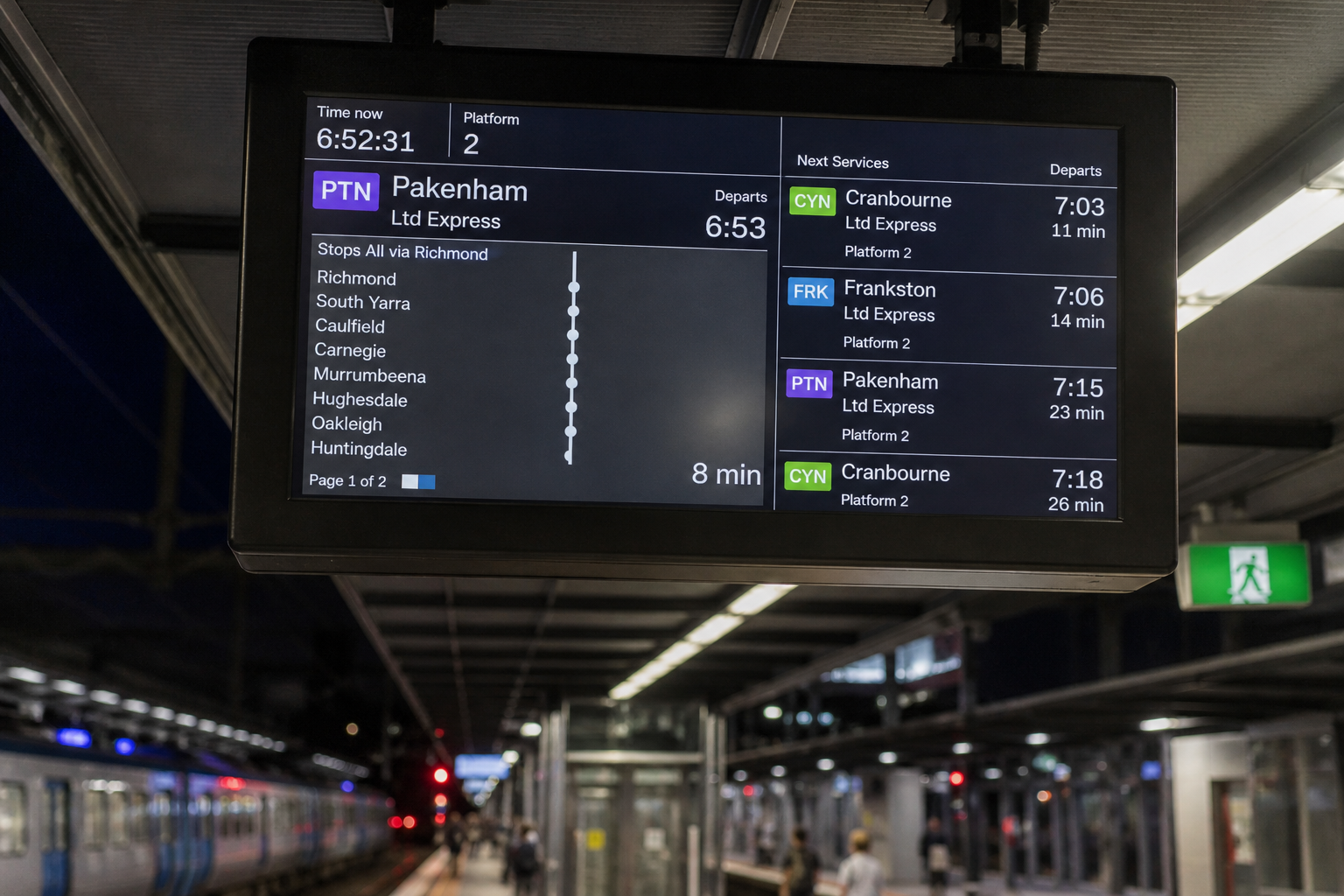
Each of these sits under one label in most procurement specifications: passenger information displays, or PIDs. The hardware, software, and certification each one needs is different.
Manuco has supplied commercial display solutions to Australian project teams since 1987, working from Thomastown in Melbourne with a partner range that includes Hyundai IT, AUO, AD Link, and DigitalView. The questions transport authority project managers and AV integrators send us tend to start in the same place: what does transport-grade hardware have to handle, and how does that change between platform, shelter, concourse, and on-board?
What makes a display transport-grade
Transport-grade describes a specification threshold. Six requirements typically separate transport-grade hardware from standard commercial signage:
- 24/7 panel rating. Transport networks run extended hours. Consumer panels rated for eight hours of daily duty fail inside a year on a 5am-to-midnight platform schedule.
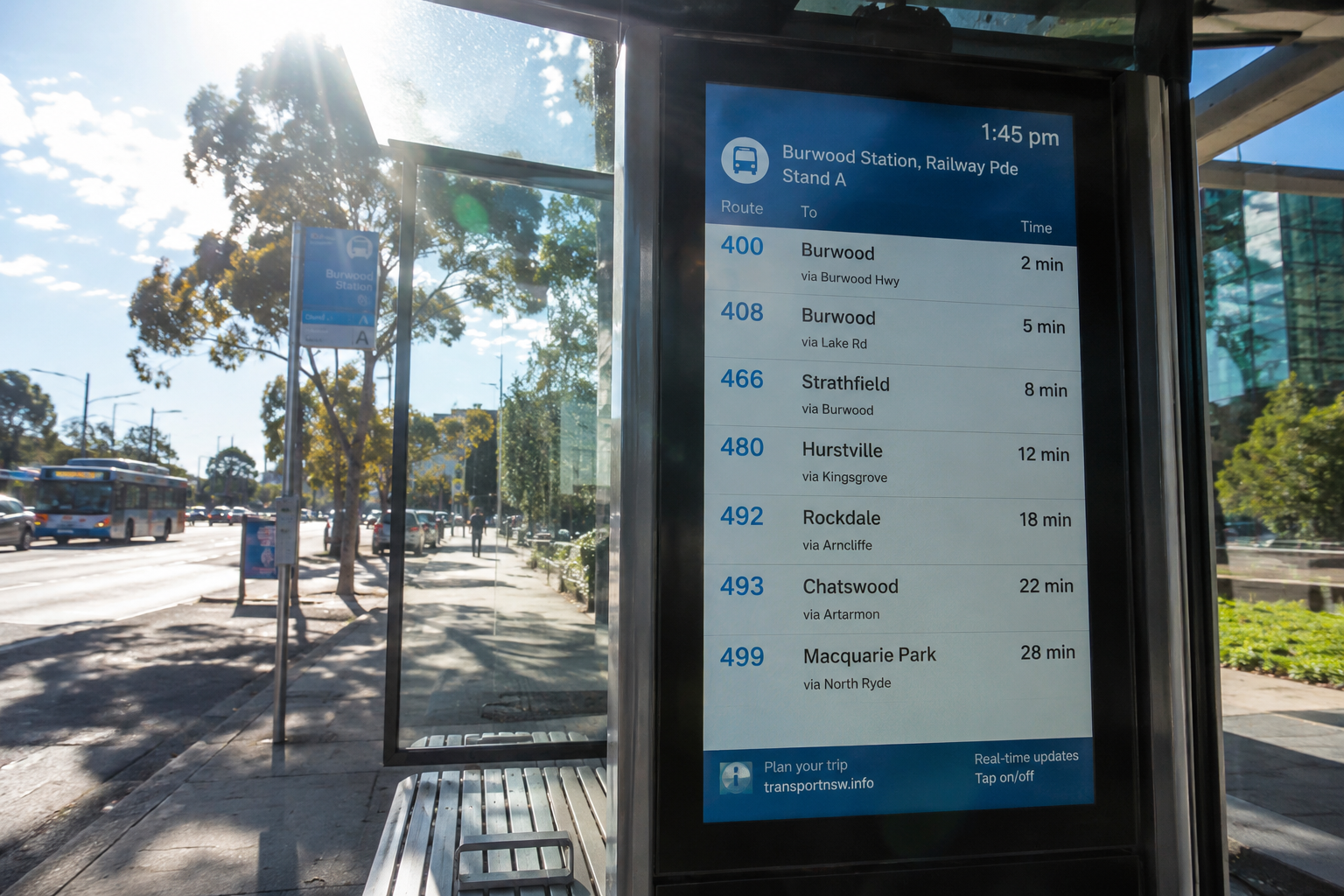
- Sunlight readability. A 700-nit panel disappears in direct sun. Open-air platforms and east- or west-facing bus shelters need substantially brighter hardware.
- IP-rated enclosures. Platform exposure, wash-down cleaning, and direct rain demand IP65 or higher. Sheltered concourse displays can run at IP54.
- Vibration tolerance. Chassis-mounted displays on buses and trams need IEC 60068-2 vibration test compliance. Static-mounted platform displays do not.
- Operating temperature range. Open enclosures see -20°C to 60°C across an Australian network. Internal display temperatures climb higher again.
- CMS-managed content. Real-time service data, scheduled content, and disruption overrides need to coexist without manual intervention at every site.
A panel that meets one or two of these may pass a tender on price. The replacement cycle eighteen months later usually proves expensive.
Brightness and readability for transport environments
Brightness specification maps directly to the lighting environment the panel sits in. The same display rated for an indoor concourse will appear black on a north-facing platform at midday.
The general ranges used in transport hardware specification:
| Environment | Recommended brightness | Notes |
|---|---|---|
| Indoor concourse | 700 to 1,500 nits | Standard commercial range |
| Covered platform with ambient light | 1,500 to 2,500 nits | Reflected daylight matters as much as direct |
| Open platform with direct sun exposure | 3,000 to 4,000 nits | Anti-glare treatment required |
| Bus shelter, east- or west-facing | 3,500 to 5,000 nits | Combined glare and heat load |
Brightness on its own does not solve readability. Anti-glare and anti-reflective surface treatments determine whether the brightness reaches the reader. A 4,000-nit panel without anti-glare coating returns a hard mirror reflection from morning or afternoon sun and washes out the content underneath.
Polarised sunglasses introduce a second readability problem. Standard LCD polarisation runs at a fixed angle, and commuters wearing polarised lenses at right angles to that axis see a black screen. Transport-grade displays address this through circular polarisers, multi-angle film, or screen rotation in the design phase. A bus shelter display that goes black for any commuter wearing polarised sunglasses is a procurement failure that surfaces only after deployment.
Vibration, thermal and ingress specifications
Outdoor and on-board displays carry a different specification stack from indoor concourse hardware. Four test classes set the boundary.
Vibration tolerance. Chassis-mounted displays on buses, trams, and rail rolling stock face continuous low-frequency vibration plus high-amplitude shock from speed bumps, rail joints, and emergency braking. The IEC 60068-2 test series is the relevant compliance reference. Static platform and concourse displays do not need this rating.
Thermal envelope. The rated operating range is a useful starting point. The internal panel temperature in a sealed outdoor enclosure is what determines failure mode. Fan-forced cooling, sealed convection, and active heat exchangers each suit different deployment environments.
Ingress protection. Each environment maps to a different IP rating threshold:
| Environment | IP rating | What it allows |
|---|---|---|
| Sheltered indoor concourse | IP54 | Dust-protected, splash-resistant |
| Covered platform | IP55 to IP65 | Splash to jet-spray resistance |
| Open-air platform, direct rain | IP65 | Dust-tight, water jet from any direction |
| Wash-down cleaning regime | IP66 | Powerful jet cleaning tolerance |
Vandal resistance. Public-accessible displays in unattended locations need impact-rated glass and an IK rating. IK10, rated for 20-joule impact, is the standard reference for accessible-to-public transport hardware. Lower IK ratings are appropriate for displays mounted above reach height or behind protective glazing.
Real-time data and accessibility compliance
Passenger information without live service data is a static timetable with backlighting. The data feed and the content management architecture decide whether the hardware does the job.
GTFS-realtime is the dominant real-time feed format across Australian transport authorities. Transport for NSW publishes Sydney Trains, NSW TrainLink, Sydney Metro, bus, ferry, and light rail data in GTFS-RT. Translink publishes South East Queensland and regional Queensland services in the same format. Public Transport Victoria provides Metro Train trip updates, vehicle positions, and service alerts in GTFS-RT. ACT light rail uses GTFS-RT, while ACT buses operate on the SIRI standard. A CMS specified for national rollout has to support both feed protocols.
Content management architecture decides what happens during a disruption. Priority override functionality lets a service alert take over the display zone without manual intervention at each site. Multi-zone layouts let advertising and service information coexist, with the service zone taking priority when timetable variance crosses a defined threshold.
Accessibility compliance sits across two reference points. AS 1428.1:2021 sets the 30 percent luminance contrast threshold for signage and tactile elements, with broader requirements for visual information presentation. The Disability Standards for Accessible Public Transport 2002, made under the Disability Discrimination Act 1992, govern accessibility of public transport infrastructure including information systems. NCC 2022 still references AS 1428.1:2009 for Deemed-to-Satisfy compliance, while the 2021 edition is acceptable under a Performance Solution. Transport authority specifications usually call up the standard their certifier approves; clarify which edition applies before committing to hardware.
Bus digital signage and chassis-mounted displays
Bus digital signage carries the strictest combined specification of any passenger information hardware. Chassis vibration, sealed enclosure thermal load, sunlight through windscreen glass, and 12V or 24V vehicle electrical systems each constrain the panel choice.
Vibration testing per IEC 60068-2 is the baseline. The mounting design matters as much as the panel itself. Rigid bracket mounts transfer vibration directly into the display. Isolation mounts using rubber bushings or spring brackets extend service life substantially.
Sunlight readability on forward-facing destination signs and on-board route displays has to handle direct sun through glass. Brightness for these positions runs in the same range as open-platform hardware, with anti-glare coating to manage windscreen reflection.
Power conditioning is the third factor. Vehicle electrical systems carry voltage spikes, drops during cranking, and load fluctuations from other on-board equipment. Transport-grade displays use input power conditioning designed for the vehicle environment.
Form factor in bus and tram applications is rarely standard. Stretched-aspect destination signs and narrow ribbon panels above the doors sit outside the 16:9 commercial range. Custom panel sourcing through a multi-brand distributor is faster than waiting on a single manufacturer's stocked range.
Sourcing and lifecycle considerations
Transport projects deploy on multi-year horizons. A station refurbishment specifying hardware in 2026 needs that hardware available, supported, and replaceable through 2032 or longer.
Service life expectations on transport-grade panels run from 50,000 to 100,000 hours depending on grade and brand. A 24/7 deployment burns through 8,760 hours per calendar year. The lower end of that range translates to roughly 5.7 years of continuous operation; the upper end approaches 11.4 years.
Parts availability is the deciding factor. A panel rated for 80,000 hours that's discontinued by its manufacturer in year three becomes a liability the moment the first unit fails. Multi-brand distributor relationships hold stock across panel partners and provide equivalent replacements when a specific line is end-of-lifed.
Local stock changes the replacement timeline. A failed display on a regional Victorian platform sits dark for as long as the supplier takes to ship a replacement. Holding spare panels at Manuco's Thomastown facility, across the partner range, compresses that window from weeks to days.
Multi-site rollout consistency is a separate consideration. When 80 bus shelters or 40 station platforms need identical hardware, the specification has to lock down at planning stage and stay locked across the rollout. Spec drift between phase one and phase three of a network deployment makes maintenance unmanageable five years later.
Common failures in transport signage projects
The same procurement mistakes show up across transport signage deployments. Five recur most often.
- Consumer-grade panels deployed under budget pressure. The price difference between a consumer 65-inch panel and a commercial 24/7-rated panel is meaningful at procurement, and meaningless 14 months later when the consumer unit is replaced. Total-cost-of-ownership calculations favour commercial-grade hardware on transport timelines.
- Insufficient brightness for the orientation. Specifying 1,500 nits for an east-facing platform means a black screen for the first two hours of every weekday morning. Site orientation has to inform brightness specification at the procurement stage. After install is too late.
- Vibration-sensitive displays mounted without isolation. Chassis-direct mounting transfers every road vibration straight to the display. Service life on directly-mounted panels routinely runs at 30 to 50 percent of isolation-mounted equivalents.
- CMS architecture without priority override. A timetable display that cannot prioritise disruption messaging fails its core role during the moments it matters most. Specifying override architecture at the CMS layer is standard practice on current transport projects.
- Hardware unsupported in Australia by year three. Imported panels supplied through international distributors carry a parts-and-service tail that is not always evident at procurement. A local distribution partner with stock and warranty support inside Australia removes that risk.
Specifying for the next infrastructure cycle
Australian transport infrastructure investment is generating substantial PID demand through the late 2020s. Western Sydney Airport rail, Cross River Rail in Brisbane, and the Suburban Rail Loop in Melbourne are each rolling out passenger information hardware at network scale. Specifying for that pipeline means committing to displays that will still be serviceable, parts-supported, and software-compatible in 2032.
Specifying hardware is the procurement decision. Maintaining the deployment over the next seven years comes back to the supplier relationship and the parts pipeline behind it.
Manuco specifies passenger information displays for Australian transport projects across multiple panel partners. Brief us on the project scope and we will work through the hardware specification with you.