

Outdoor kiosks have quietly become one of the fastest growing pieces of civic hardware in Australia, turning up in places that once relied on corkboards, paper timetables, or a single staff member at a counter. Councils, transport agencies and tourism operators are investing in them for a simple commercial reason: they solve a mounting information problem at a time when the public expects accuracy on demand.
New data from the Australian Communications and Media Authority shows that 86 percent of Australians now access the internet outside the home. That shift has changed how people look for directions, updates, and services in public settings.
“If the information is not immediately available on their phone, they expect the environment around them to fill the gap”, says Vincent Yeow, from Manuco Electronics. “Outdoor kiosks have become the fallback system.”
For decision makers, the appeal is less about digital glamour and more about operational certainty. A kiosk does not take breaks, does not get pulled away to answer another question, and does not fall out of date when an event or timetable changes at short notice. It provides a single, visible source of truth in locations that are under pressure to keep people moving.
That utility is driving growth. Regional towns use kiosks to manage rising visitor numbers. Transport networks rely on them to support real time communication. Universities deploy them to steer students around expanding campuses. Retail precincts and quick service operators see value in placing self service tools outside their front doors. What was once an occasional feature has become infrastructure.
The demand driving outdoor kiosk adoption
Outdoor kiosks are not spreading because they are new. They are spreading because they answer a set of practical problems that neither mobile networks nor traditional signage reliably solve.
The main drivers include:
- More people rely on digital tools in outdoor settings
- Visitor foot traffic is rising in many regional areas
- Printed signage cannot keep pace with frequent updates
- Mobile reception is inconsistent in busy or remote locations
- Councils and operators are expected to provide real time information
- Staffing models can no longer support constant one to one assistance
Outdoor kiosks fill these gaps by providing a controlled, highly visible digital touchpoint that works around the clock.
What outdoor kiosks do well
Outdoor kiosks handle tasks that are difficult to manage with human staffing or fixed, printed signs.
Common uses
- Timetable lookups for trains, buses, ferries, and regional services
- Wayfinding in town centres, precincts, attractions, and campuses
- Local notices and council updates
- Tourism information and visitor guidance
- Ticketing for events or transport
- Ordering or check in for retail and quick service restaurants
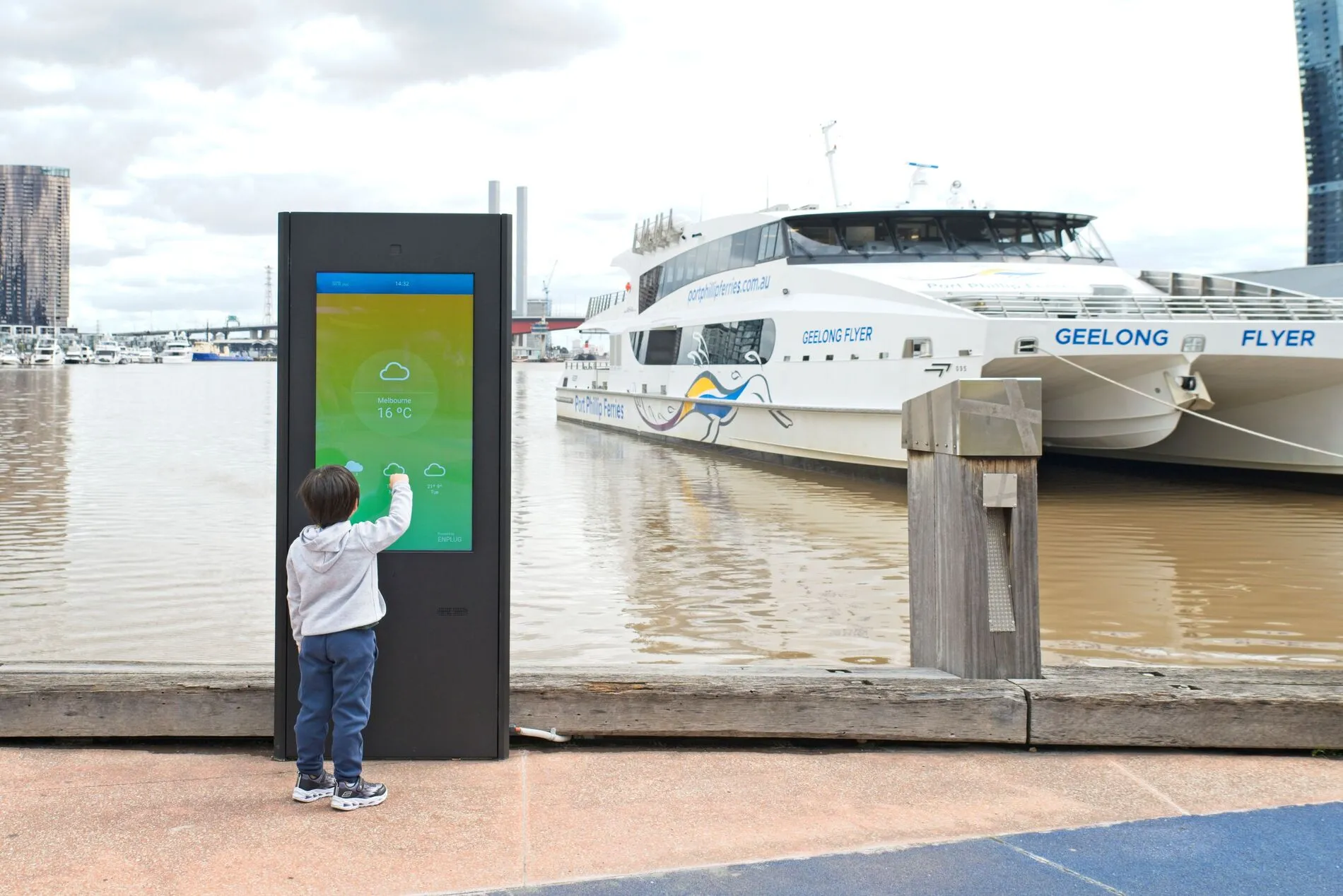
Why organisations deploy outdoor kiosks
| Priority | How kiosks help |
| Reducing pressure on staff | Kiosks answer repetitive questions automatically |
| Improving accuracy | Content updates in real time |
| Managing high foot traffic | People self serve rather than join queues |
| Supporting visitors | Helps people who are unfamiliar with the area |
| Ensuring consistent messaging | One source of truth for timetables and alerts |
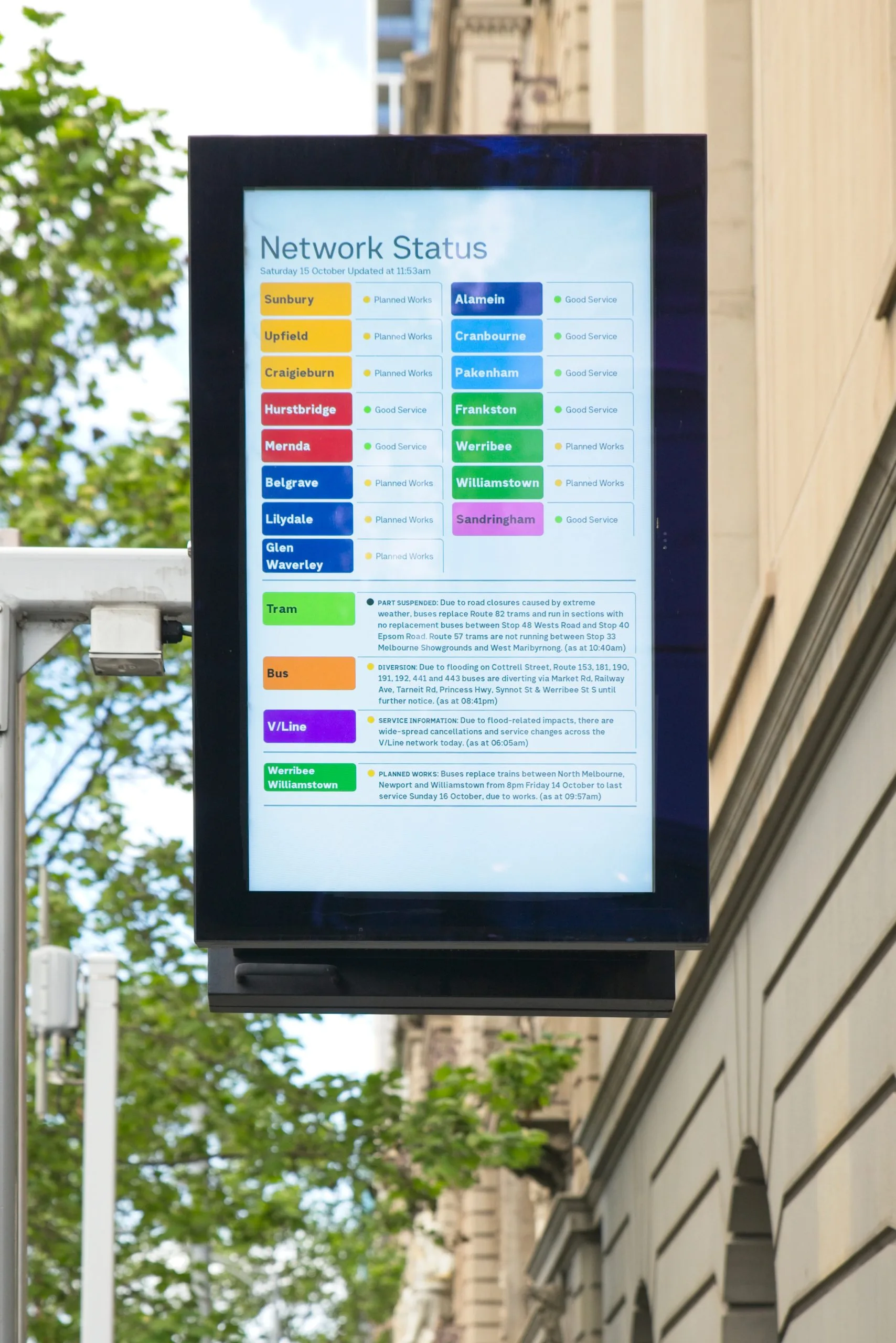
Kiosks built for Australian conditions
Australia has harsh outdoor conditions, and consumer grade displays cannot survive long in public spaces. Outdoor kiosks use commercial components and engineered enclosures designed for heat, sunlight, dust, and heavy use.
Environmental challenges
- Extreme UV exposure
- High heat in summer
- Rapid temperature changes
- Strong winds and storm events
- Dust, insects, and moisture
- Public wear and tear
Outdoor kiosk hardware versus typical indoor screens
| Feature | Indoor or Consumer Display | Outdoor Kiosk Display |
| Brightness | 250 to 400 nits | 2000 to 3500 nits sunlight readable |
| Weather protection | None | Sealed IP rated enclosure |
| Thermal stability | Limited | Wide operating range and active cooling |
| Structural strength | Light duty | Reinforced and anti vandal construction |
| Longevity outdoors | Very low | Designed for multi year continuous use |
Components that improve durability
- High brightness commercial grade LCD panels
- Laminated or tempered anti vandal glass
- IP rated housings that block dust and moisture
- Internal thermal systems with controlled airflow
- Corrosion resistant materials suitable for coastal locations
Where is Kiosk Use Rising in Australia?
The rise is not confined to one sector. Several industries have found practical reasons to build outdoor kiosks into their public infrastructure.
Government and councils
- Community notices
- Service information
- Visitor guidance in civic precincts
- Multilingual updates in diverse communities
Transport networks
- Real time schedules
- Route planning
- Service alerts during disruptions
- Wayfinding within large stations
Tourism and regional development
- Local maps and walking trails
- Attraction overviews
- Seasonal activity guides
- Hospitality and retail discovery tools
Education and campuses
- Building directories
- Event information
- New student orientation support
Commercial operators
- Self service ordering before entering stores
- Extended hours services outside shopfronts
- Queue management in busy precincts
Planning an effective outdoor kiosk deployment
Deploying a kiosk is more than placing a screen outdoors. Good planning determines whether the installation performs well and remains reliable.
Key planning points
-
Placement: should be visible, accessible, and easy to approach
-
Climate compatibility: hardware must match local heat, humidity, and exposure
-
Screen size: determined by viewing distance and type of content
-
Connectivity: stable network access for real time updates
-
Power management: efficient operation to reduce running costs
-
Remote monitoring: early detection of faults or outages
Mistakes to avoid
-
Using indoor or consumer grade screens
-
Installing kiosks in direct, unshaded locations where heat rises rapidly
-
Ignoring accessibility requirements such as reach height and clear ground space
-
Underestimating maintenance needs in coastal areas
-
Choosing software that is not designed for public use
Why outdoor kiosks are becoming standard infrastructure
Outdoor kiosks simplify public interactions in environments that are becoming more complex. They help councils stretch limited resources, assist transport operators during peaks and disruptions, support tourism bodies handling rising visitor numbers, and give businesses a way to serve customers outside normal hours.
They are not a trend item. They are a tool that addresses the growing expectation that information should be accurate, up to date, and available on demand, even outdoors.
Sources and Further Reading
Australian Communications and Media Authority, Communications and Media in Australia
https://www.acma.gov.au/publications
Tourism Research Australia, National Visitor Survey
https://www.tra.gov.au
Transport for NSW Projects and Digital Programs
https://www.transport.nsw.gov.au/projects
Victoria Department of Transport and Planning
https://www.vic.gov.au/department-transport-and-planning
Australian Government Smart Cities Program
https://www.infrastructure.gov.au/territories-regions/cities