

In Victoria, a screen that shows still or moving images is an electronic sign under the planning scheme. In most zones it needs a planning permit from the council before it can be switched on. The rules sit in Clause 52.05, and the zone decides what is possible. In commercial, office and industrial areas a permit is required. In high amenity areas the display area is capped at 3 square metres. In the most sensitive areas a screen is only allowed on a freeway service centre or service station site, and is capped at 3 square metres there too. If the sign sits within 60 metres of a declared freeway or arterial road, the application is also referred to the state roads authority.
That question stalls a project after the hardware has been chosen. The display is specified, the mounting position is settled, and then somebody asks about council. Project managers, AV integrators and procurement officers all hit it at the same point.
What counts as an electronic sign under the Victorian planning scheme
The planning scheme defines sign types at Clause 73.02, and two of those definitions catch a screen.
An electronic sign is “a sign that can be updated electronically. It includes screens broadcasting still or moving images.” An animated sign is “a sign that can move, contains moving or scrolling parts, changes its message, flashes, or has a moving or flashing border.” A digital menu board changes its message, so it is both.
The trap is assuming the content saves you. A screen showing the business’s own name is a business identification sign. That type is often permit free. It is also an electronic sign. Clause 52.05-2 settles the overlap: where a sign can be read in more than one way, the most restrictive requirement must be met.
One exemption is worth knowing. Under Clause 52.05-10, a sign inside a building that cannot generally be seen outside needs no permit. A shop window screen is put there to be seen from outside, so it does not qualify.
When you need a permit, and when a digital sign is not allowed at all

Clause 52.05 sorts signs into four categories of sign control. The zone provisions say which category applies to a site. Each category has three sections. Section 1 signs need no permit, if every condition beside them is met. Section 2 signs need a permit, and if the conditions are not met the sign is prohibited. Section 3 signs are prohibited outright.
An electronic sign is not in the permit free list of any category. Here is where that lands.
| Category of sign control | Where it applies | An electronic sign is |
|---|---|---|
| Category 1, commercial areas | Commercial zones | Not permit free, so a permit is required. Nothing is prohibited in this category. |
| Category 2, office and industrial | Office and industrial zones | Not permit free, so a permit is required. Nothing is prohibited in this category. |
| Category 3, high amenity areas | Zones with medium amenity control | A permit is required and the display area must not exceed 3 square metres. Above that the condition is not met, so the sign is prohibited. |
| Category 4, sensitive areas | Zones with the strongest amenity control | A permit is required, and only on land used for a freeway service centre or service station, with a display area of no more than 3 square metres. On any other land in these zones it is prohibited. |
The 3 square metre cap in Categories 3 and 4 is the number to check first. In a standard widescreen shape, that is a little over 100 inches on the diagonal. It rules out a large format screen, so check the category before you size the screen.
One more thing affects the timeline. Clause 52.05 includes a VicSmart fast track class for signs. It names electronic and animated signs as exclusions, so a digital sign cannot take the short assessment path.
What the 60-metre rule near a freeway or arterial road means for your project
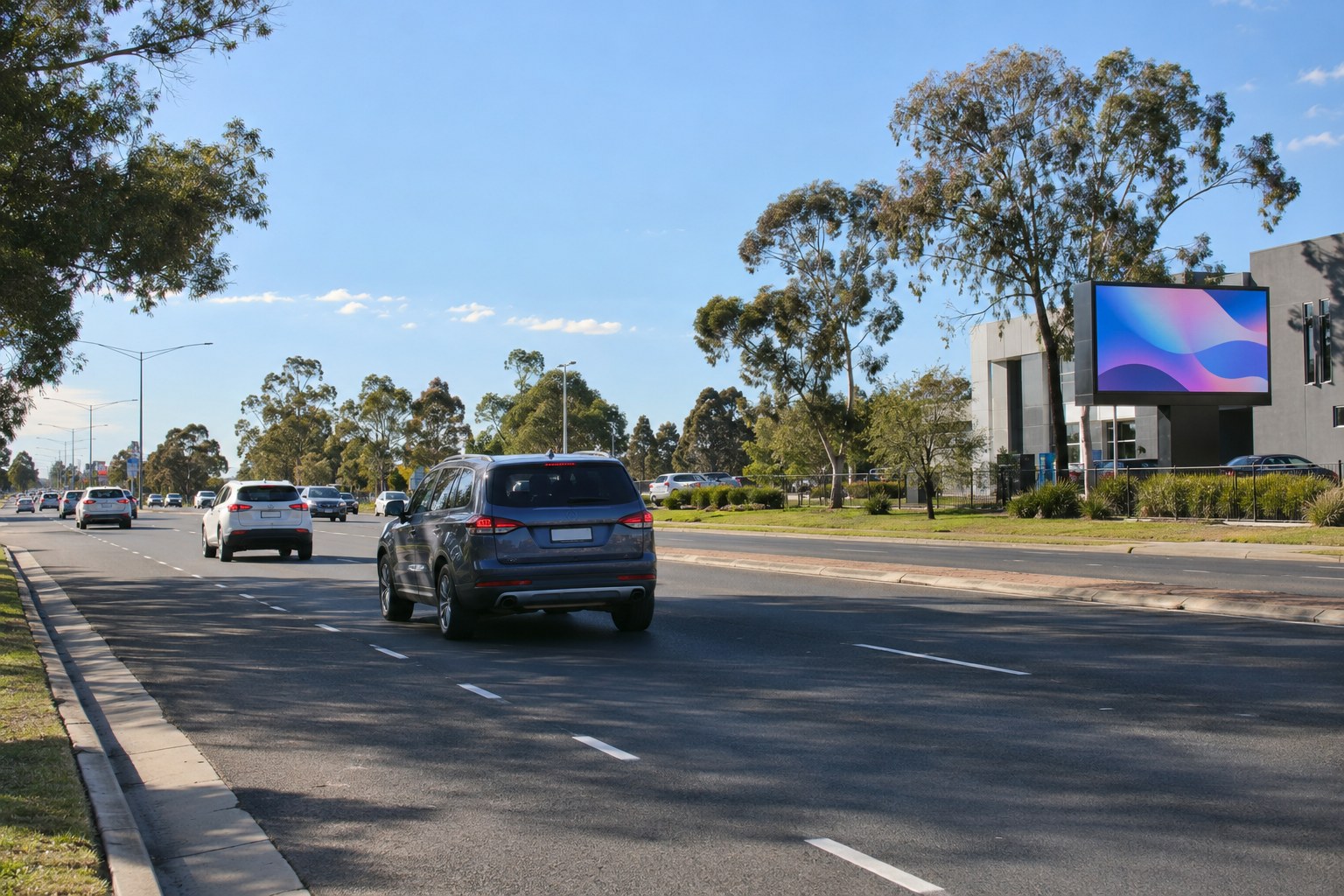
Clause 52.05-3 adds a second decision maker on some sites. It catches an animated or electronic sign within 60 metres of a freeway or arterial road declared under the Road Management Act 2004. An application for one must be referred under section 55 of the Planning and Environment Act 1987. The referral authority is named in Clause 66.03.
In practice that is the Head, Transport for Victoria. The Department of Transport and Planning assesses the application under delegation. Its published concern is road safety: where the sign is, how it is oriented, how bright it is, and the road network around it. What the sign says is not the issue.
Sixty metres is closer than it sounds. A forecourt screen facing a main road can sit inside the trigger. So can a warehouse frontage on an industrial estate in Melbourne’s north. Measure it at design stage, because a second authority is far easier to plan for than to discover after lodgement.
What the council and the department will ask you to submit

Clause 52.05-6 sets out what a sign application must include. Most of it is the sign contractor’s work: the site context report, the sign’s dimensions and structure, and its colours, materials and display area.
Three items depend on the display itself.
- Details of any illumination, including baffles and the hours the sign would be lit.
- For an animated or electronic sign, a report addressing the road safety decision guidelines at Clause 52.05-8.
- For a sign of 18 square metres or more, lux levels where it sits on or within 60 metres of a Transport Zone 2 or 3, a residential zone or a public land zone. The dwell and change time for any non static images is needed too.
The term you meet next is a lighting impact assessment, and it is rarely explained. It is a report by a qualified lighting consultant. It classifies the site’s night time brightness as high, medium or low district brightness. It states the proposed maximum luminance for each lighting condition, with the calculations behind it. It shows the sign from a driver’s viewpoint. And it certifies that the design meets the department’s requirements.
Clause 52.05-8 is where the council weighs it up. Two decision guidelines matter to whoever specifies the screen. One asks whether the sign could dazzle or distract drivers through its size, design, colouring or illumination. The other asks whether the illumination can be controlled by time of day or by intensity. That second one is a question about your hardware.
What this changes about the display you specify
The number that decides whether a screen can meet permit conditions is not its peak brightness. It is how far down the screen can dim, and how that dimming is controlled. When you compare outdoor display options, start there rather than with the headline brightness figure.
The Department of Transport and Planning’s Requirements and Guidelines for Illuminated Outdoor Advertising Signage, version 3 dated 4 October 2023, sets the luminance limits for signs referred to the Head, Transport for Victoria. Luminance is measured in candela per square metre, the same unit as a nit.
| Lighting condition | Category A sign | Category B sign |
|---|---|---|
| Full sun on the face of the sign | No limit | No limit |
| Daytime | 6,000 | 4,000 |
| Morning and evening twilight, and overcast weather | 700 | 400 |
| Night, high district brightness | 350 | 200 |
| Night, medium district brightness | 250 | 150 |
| Night, low district brightness | 150 | Not permitted |
Category A covers high wall, major promotion, panel, pole and sky signs, plus promotion signs over 3 square metres. Category B covers promotion signs up to 3 square metres. The document illustrates Category B with bus and tram shelter panels and digital TV screens behind a shop window. District brightness follows AS 4282:2019. High is a lit town centre or commercial area, medium is suburban, and low is sparsely inhabited rural with little or no street lighting.
Read that table from the bottom up. A 3,500 nit outdoor display sits well under the 6,000 daytime ceiling for a Category A sign. The same screen has to come down to 350 cd/m² or lower at night in a town centre. On an unlit rural road it is 150 or lower. Getting bright is the easy half. Getting dim on cue is the harder specification.
The department’s standard permit conditions turn that into three questions to ask at quote stage.
- The sign must be dimmable, with a control system that lets the maximum lighting level be set or adjusted.
- Where the sign is lit during the day, it must have a photocell. That is a light sensor that reads ambient light, paired with control technology that adjusts the screen’s luminance automatically.
- Where the content or the colours change, the image change must happen in 0.1 seconds or less. Dwell and transition behaviour are set in the content player, not the panel, so confirm the player can switch inside that window.
Two more conditions catch projects out. Electronic signage must have an upward light ratio below 50%, with something like integral baffles to cut waste light going upward. And the department may require a compliance record. That logs luminance and the photocell reading at least every ten minutes, plus dwell and transition times. Everything is time stamped, kept for twelve months, and handed over within five days of a written request. It is a logging capability, and far cheaper to specify than to retrofit.
The lighting consultant also needs photometric data for the screen. Ask your supplier early whether they can provide it, because the report cannot be written without it.
None of this is about daylight readability. How many nits a screen needs to stay readable in direct sun is a different question.
Weather protection is different again. IP rating, a measure of how well a housing keeps out dust and water, and the operating temperature range decide whether the screen survives an Australian summer, not whether it gets a permit.
Who applies for the permit, and who decides

The council is the responsible authority and decides the application. Where the 60 metre rule applies, the Head, Transport for Victoria is a referral authority and the department assesses that part. The applicant is usually the site owner or the sign contractor. It is not the display supplier, whose job is the specification and the evidence about how the screen behaves.
Clause 52.05-4 gives only two kinds of sign a default expiry date. One is a major promotion sign. The other is a promotion sign advertising goods, services or events that are not provided on the land the sign sits on. For those two, the permit expires on the date written into it, and where no date is written in, 15 years from issue. A screen promoting what the business on that site sells is neither, so no default expiry applies to it. That narrowing took effect on 27 October 2025, so read the permit itself rather than assuming a 15 year life. A screen going onto a structure approved years ago is not necessarily covered by that old permit either, because a replacement that results in a different type of sign needs its own.
Overlays sit on top of all of this. Some require a permit even for a Section 1 sign, and in a heritage overlay any sign needs one. Check the overlays on the title before you rely on a category.
This article is general information about the Victorian planning scheme, not planning or legal advice. Your local council is the authority on its own scheme, and the place to confirm what applies at a given address.
If you are specifying a screen for a Victorian site, send the site address, the mounting position and the road the screen will face when you get in touch. With those three details the specification can be built to survive the lighting assessment rather than be revised after it.
Frequently asked questions
Does a screen in a shop window need a planning permit?
The exemption for indoor signs only covers one that cannot generally be seen from outside, and a window screen is placed there to be seen. So it does not qualify, and the zone’s category of sign control decides what applies.
Who applies for the permit, the sign company or the site owner?
Whichever of them is managing the installation, and it varies by project. The display supplier is not the applicant, although the specification data they provide ends up inside the application.
Can a digital sign go through the VicSmart fast track process?
No. The VicSmart class for signs names electronic and animated signs as exclusions, so a screen is assessed the ordinary way.
How long does a signage permit last in Victoria?
Until the expiry date written into the permit. Only two kinds of sign carry a default where the permit names no date: a major promotion sign, and a promotion sign for goods or services not supplied on that site. Anything else, including a screen advertising the business on the land, has no default expiry.