What makes a shopping centre wayfinding kiosk worth using
A specifier's guide to wayfinding kiosks for shopping centres: duty cycle, glare, vandal-resistant touch and…


You ask two suppliers to quote the same shopfront screen. One comes back with an “LED display”, the other with an “LCD panel”, and the prices are thousands of dollars apart. Often they are quoting the same kind of screen under two different names. Sometimes they are quoting two completely different technologies. Telling which is which is the difference between a sound spec and a costly one.
Digital displays for business come in two families, and the label on the box rarely tells you which one you are buying. Manuco supplies commercial displays to integrators and project teams across Australia and New Zealand from its base in Thomastown, in Melbourne’s north, and the first question on almost every job is the same: does this site need an LCD, or a direct-view LED screen? The answer usually comes down to how far away people stand and how big the screen has to be.
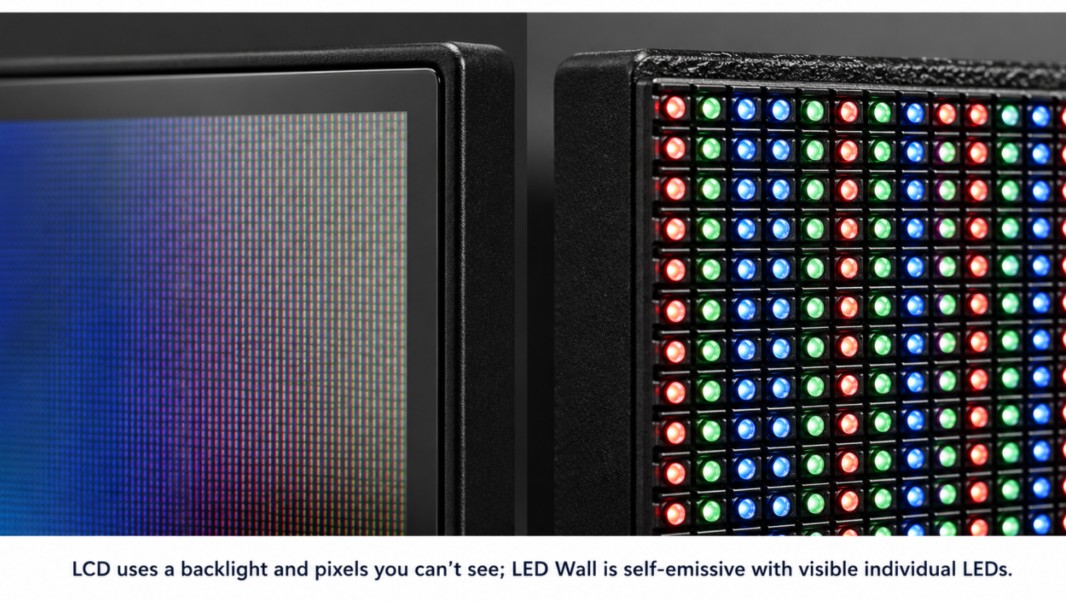
An LCD, or liquid crystal display, makes its picture with a layer of liquid crystals that twist to let light through. The crystals do not make their own light, so the panel needs a backlight behind them. In modern displays that backlight is a set of LEDs, which is why so many LCD screens are sold as “LED”. They are still LCD panels. The LED part is only the light source. The full name for the panel is TFT LCD, the same technology in most phones, laptops, and monitors.
A direct-view LED display works in a different way. It has no liquid crystal layer and no backlight. The picture is made by thousands of tiny red, green, and blue LEDs that emit light directly, packed onto panels that lock together into a larger screen. In the commercial display trade, an “LED display” usually means this kind of screen. In a consumer electronics shop, the same words usually mean an LED-backlit LCD.
So the same three letters describe two very different products. Most screens you would recognise as a flat panel are LCD. The seamless walls at airports, the boards at stadiums, and large outdoor billboards are direct-view LED. Here is how they compare.
| Feature | Commercial LCD | Direct-view LED |
|---|---|---|
| How the image is made | Liquid crystals lit by an LED backlight | Tiny LEDs form the pixels directly |
| Best viewing distance | Arm's length to a few metres | A few metres to across a street |
| Typical sizes | Single panels up to about 100 inches | Any size, built from panels, no real limit |
| Joins | Bezels show when panels are tiled into a wall | Seamless, with no visible joins |
| Brightness | 300 to 700 nits indoors, up to 3,000 outdoors | 1,000 to 5,000 nits and beyond, strong in sun |
| Up-front cost | Lower | Higher, and highest for fine pitch |
| Best for | Menu boards, wayfinding, reception, shopfronts | Feature walls, stadiums, large outdoor advertising |
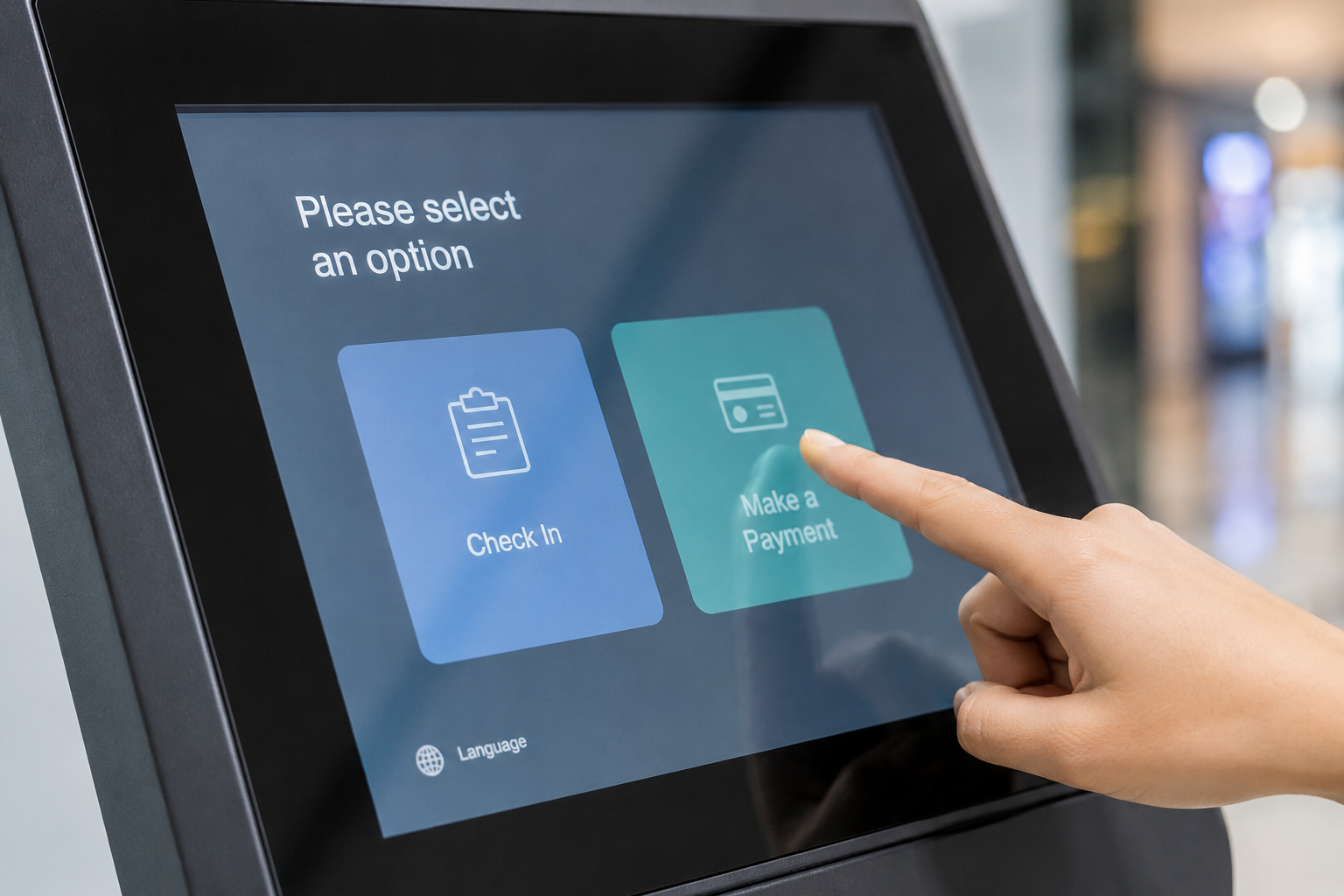
For most commercial signage jobs, a commercial LCD is the right tool. It is sharp at close range, it renders text and pricing cleanly, and it costs less to buy. If people read the screen from arm’s length to a few metres away, an LCD is almost always the answer.
That covers most of what a display does inside a building:
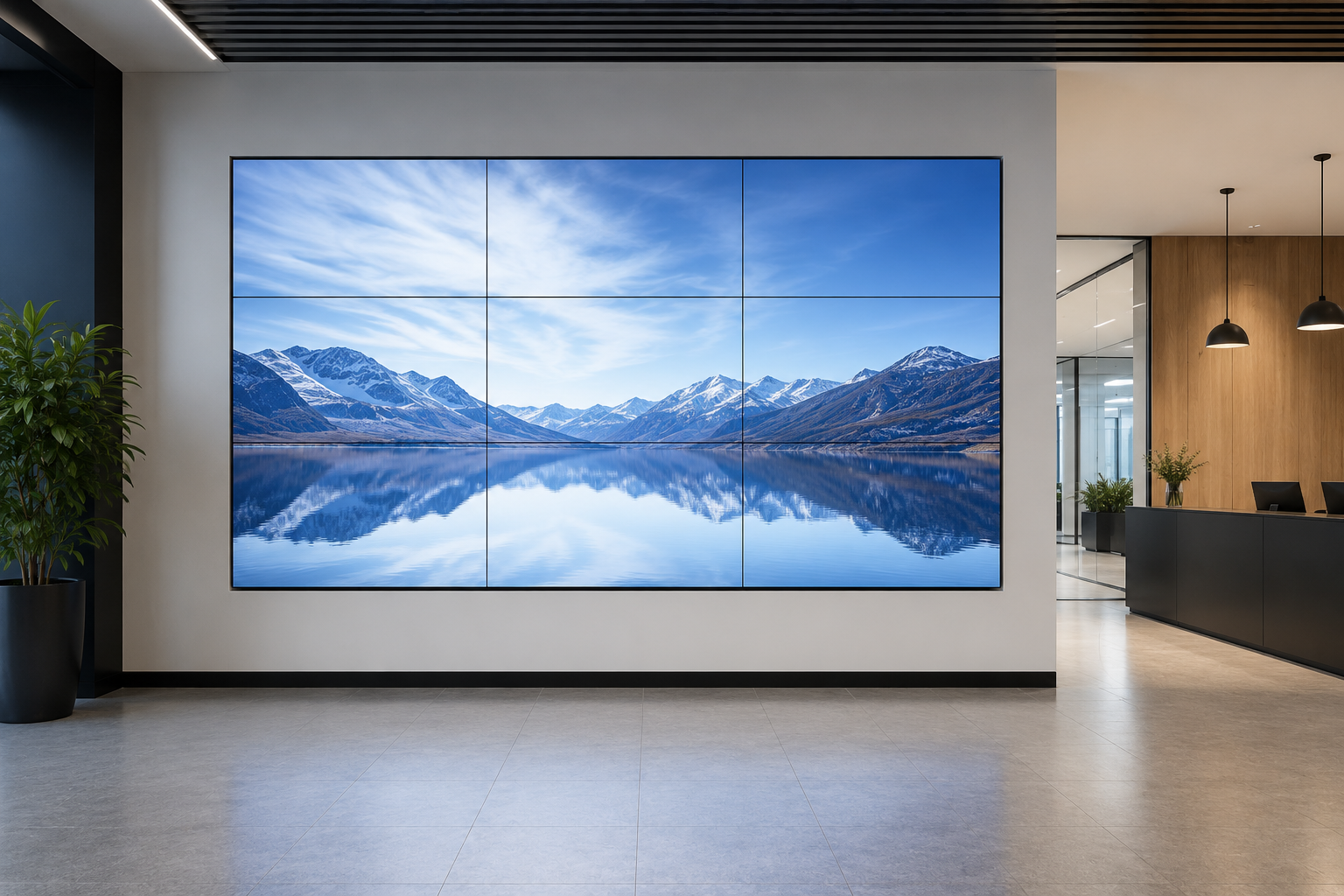
Commercial LCD panels are rated to run 16 or 24 hours a day for years, which a consumer TV is not. One thing to plan around: a single LCD panel tops out at around 100 inches. Past that size you either tile several panels into a video wall or move to direct-view LED. Tiling LCD panels leaves thin bezel lines across the image, which is fine for a data wall and wrong for a seamless feature wall.
Direct-view LED earns its higher price in a few clear situations. If any of these describe the job, an LED screen is worth the spend:
The trade-off is up-front cost and, for close viewing, sharpness. A direct-view LED screen’s clarity depends on its pixel pitch, the gap between the LEDs, measured in millimetres. A fine pitch under 2mm looks sharp from a few metres but costs the most. A coarse 10mm pitch suits a billboard seen from across a car park but looks blocky up close. The finer the pitch you need, the more the screen costs. Sizing an LED wall and choosing a pitch is a job of its own, and it overlaps with how you plan any video wall.
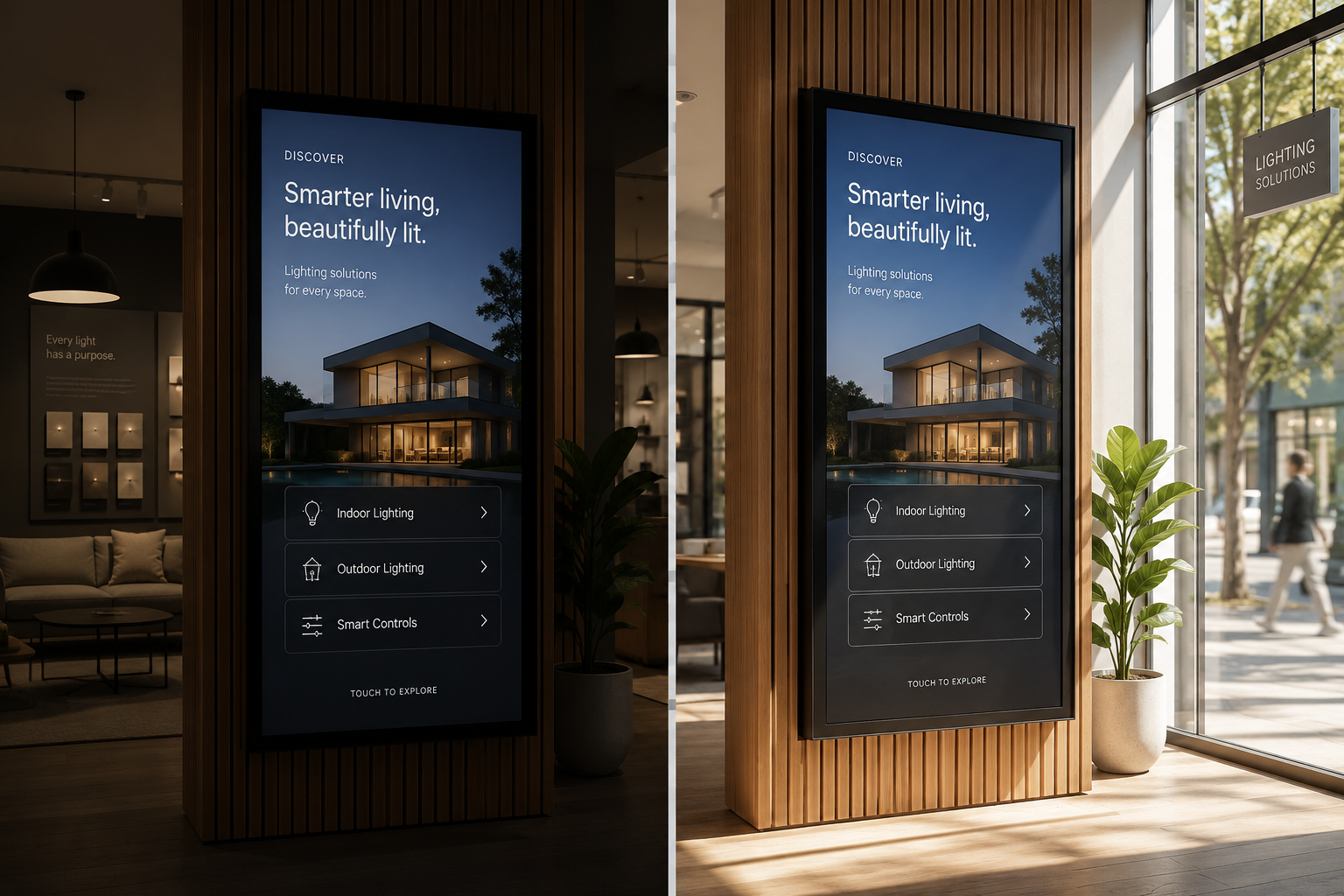
Outdoor is where the LED and LCD question gets sharpest, because the Australian sun is punishing. A screen that looks brilliant in a showroom can wash out to a grey rectangle on a north-facing forecourt in January.
There are two sound options outdoors, and they suit different jobs.
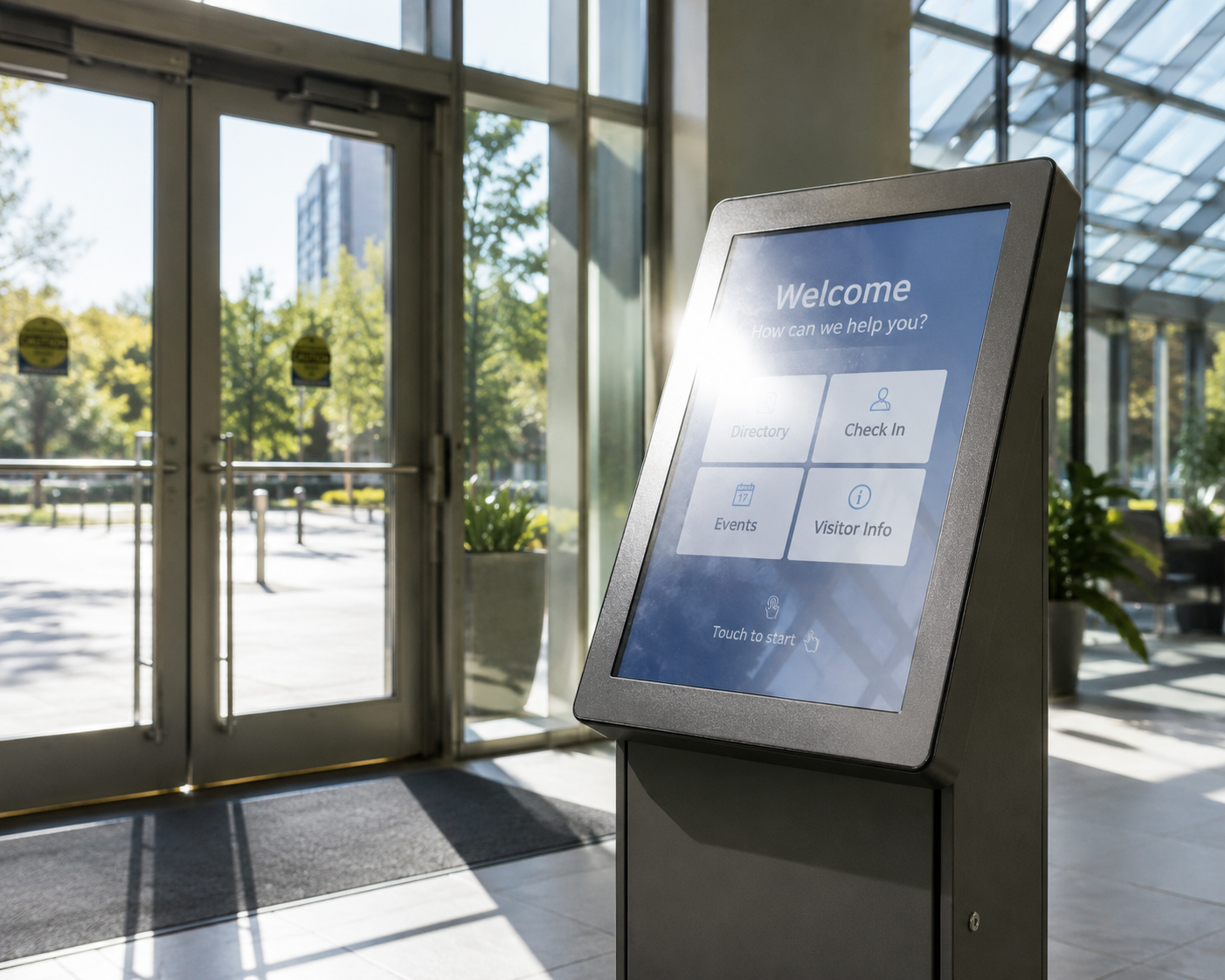
A high-brightness outdoor LCD handles most outdoor signage at human scale: bus-shelter passenger information, drive-through menu boards, wayfinding at a shopping centre entry, or a kiosk in a forecourt. These are read from a few metres away and need to stay sharp. An outdoor LCD monitor rated to around 2,500 to 3,000 nits, sealed against dust and rain and fitted with automatic brightness control, stays readable in full sun. This is the workhorse for outdoor display screens people walk up to.
A direct-view outdoor LED display is for the large-format end: a building-side advertising screen, a big roadside board, or a stadium perimeter. These are seen from across a street or a field, so the pixel pitch can be coarse and the brightness can run past 5,000 nits. This is what people usually mean by an outdoor LED display or an LED billboard.
The costly mistake is paying for a direct-view LED wall where a high-brightness outdoor LCD would have been sharper and cheaper for a screen people read up close. The opposite mistake, putting a standard indoor LCD in a west-facing window, ends with a display no one can read by mid-morning. Weatherproofing, IP ratings, and heat all matter once a screen is outdoors, and they apply to both technologies.
On the quote, an LCD almost always costs less than a direct-view LED screen of the same size. For a single reception panel or a menu board, the LCD wins on price with room to spare.
The picture changes at large format and over time. A direct-view LED wall has no backlight to dim or fail, tolerates heat and weather well, and its panels can be serviced one module at a time rather than replaced whole. For a large screen that runs for years in a demanding spot, LED can work out cheaper across its life even though it costs more up front. For a standard indoor display, that longevity rarely makes up for the higher purchase price.
Buyers often ask about OLED as a third option. OLED screens make their own light for each pixel and give superb contrast, but they are prone to burn-in when the same logo or menu sits on screen all day. For static signage that shows the same content for hours, OLED is usually the wrong fit. LCD and direct-view LED are the two technologies built to handle signage duty.
The decision comes down to three questions about the site:
Answer those three and the technology usually picks itself. The displays that fail early are almost always the ones chosen from a size and a price alone, without matching the technology to where the screen sits.
If you are scoping a project and are unsure which way a particular screen should go, the quickest path to a sound spec is to describe the site: the viewing distance, the screen size, the light it has to beat, and the hours it runs. Send those details to Manuco and you will get a display specification built around that site. On a multi-screen job, this is also where you sort out which displays can share one model and which need their own.
Web Design by CJ Digital